Translate

Saturday, April 13, 2013

April 13th, 2013: First Day!


Today will mark the first official day of the 2013 fishing season.  A few of us will be heading out to Amalga Harbor to try our hand at Steelhead trout fishing.  There is a small creek that empties into a lake right before the ocean and word has it that there is some decent trout fishing there this time of year.  Amalga Harbor is located about 17 miles outside of town and is accessible from the main road.  There is a boat launch at the parking lot, however we will be fishing just north of the boat launch.  There should be trout running in the Juneau area from April to mid-June with the peak of the season in May.
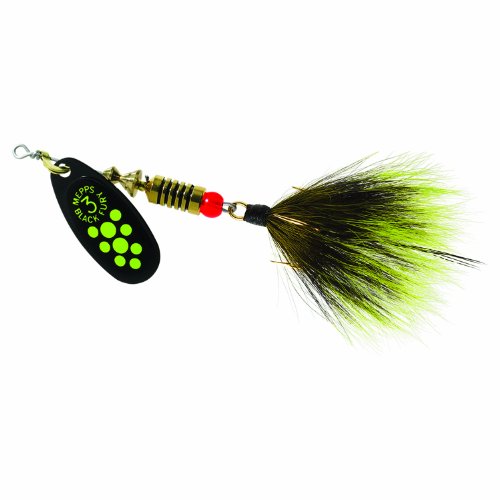
Rod & Reel Setup:


  •  6-6.5 foot length pole
  •  4-6 pound test line
  •  Spinner lure weighing 1/16 to 1/4 ounces

This basic setup will allow you to get into the tight spots where trout will likely be.  When you are fishing a creek or river cast anywhere from a 45 to 90 degree angle upstream from the bank and allow your line to float downstream.  This allows you to cover more ground and increase the chances of you finding a good spot where the fish are.  Keeping this in mind, if you are using to heavy of a lure it will sink and most likely get caught in branches, downed logs, or rocks.  

Trout Species in Southeast Alaska


There are three main trout species that live in fresh water in Southeast Alaska and are as follows:

Steelhead/Rainbow Trout (Oncorhynchus mykiss):
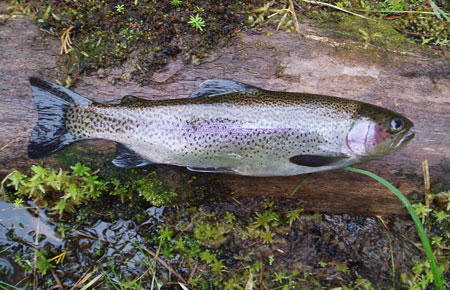
Rainbow and Steelhead trout are the most widely known trout in the world and are highly sought after by anglers because of their strong fighting abilities.  In Alaska, there are two commonly recognized forms of the rainbow trout and these sup-groups or "forms" are based primarily on where they spend their time feeding and maturing.  The most common rainbow trout in Alaska is the stream-resident form that lives its life entirely in freshwater with maybe short periods of time spent in esturaine or near-shore marine waters.  The second form is commonly known as Steelhead and these rainbow trout leave freshwater as juveniles and migrate long distances in the ocean where they grow to maturity before migrating back to their original waters.  Their length can range up to 45 inches and weigh up to 55 pounds.  


Cutthroat Trout (Oncorhynchus clarkii):
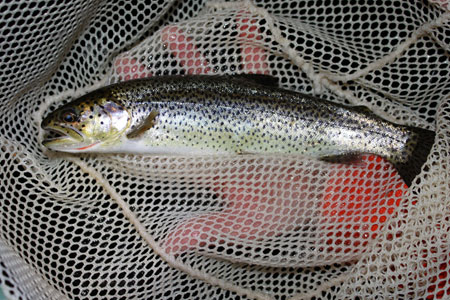
Coastal cutthroat trout occur as sea-run or freshwater-resident forms in streams and lakes along the coastal range from lower Southeast Alaska to Prince William Sound and are the most common trout species in the region.  The freshwater-resident form lives in a wide variety of habitats, from small headwater tributaries and bog ponds to large lakes and rivers.  Sea-run cutthroat trout are usually found in river or stream systems with accessible lakes, mostly south of Fredrick Sound.  In some watersheds, like the Taku River, the two forms are found together.  The extent of breeding between the two forms is unknown, and the reason that some fish migrate to sea while others stay in fresh water remains an interesting question.  Freshwater-resident fish living in small ponds or streams are typically 6-16 inches in length.

Lake Trout (Salvelinus namaycush):
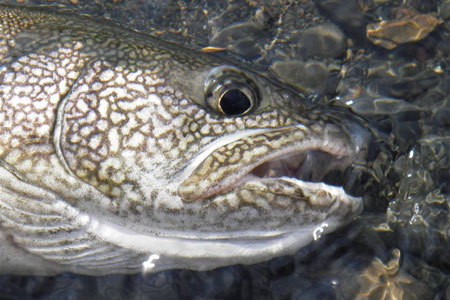
Lake trout have a body shape similar to that of trout and salmon.  they generally have small cream or yellow irregular shaped spots on a silvery-to-dark background.  Males and females are similar, with males having a slightly longer, more pointed snout.  Lake trout can be distinguished from other chars by the absence of pink spots and their deeply forked tail.  A breeding male has dark stripes on its side, and lacks the red or orange exhibited by Dolly Varden and Arctic Char.  There is usually a white leading edge on the pectoral, pelvic, and anal fin.  Alaska lake trout can live longer than 50 years but more typical maximum ages are around 20 years.  The maximum size attained in some Alaskan populations probably exceeds 50 pounds, and 8- to 10-pound fish can be taken in many of the state's fisheries.  The current record is a 47-pound laker caught in Clarance Lake in July 1970.

*Trout information credit:  Alaska Department of Fish and Game

I hope this small trout guide is helpful and I will be updating this section of the blog with current catches and locations (but not to specific) throughout the season.


Happy fishing!

Thank you for reading and if you like this blog please subscribe and share.

-Eric
4.13.13


Wednesday, April 10, 2013

Fishing Recap 2012


Stika (July 11-15)
Last year was a very interesting year for fishing in Alaska.  It was my first trip to Sitka for some real king salmon fishing.  We spent four days out fishing on a little 15' Boston Whaler.  The limit for any given day was around 12 kings.  The picture below was from day 2.  The largest king we caught that day was around 20 pounds.  
On this day I actually caught the large one on the bottom right, and he actually snapped my pole right in half but i managed to reel him in and net him!  The only reason the pole snapped in the first place was because I tried to set the hook right as he pulled away and the combined pressure definitely was too much for my pole.  A big thanks to Devin for taking me around Sitka and showing me how to set a halibut line as well as the good spots to fish for king salmon, Sockeye salmon, and halibut.  A general word of advice for fishing in Sitka is you have to have someone with a boat to get to the good spots.  Most of them are not accessible from hiking trails.  If you do plan on hiking to your fishing spot be forewarned bring a gun as there are black and brown bears.  On the last day in town, we decided to hit up Redoubt Cove which is a large river mouth that empties into a cove where all of the Sockeye salmon go to spawn.  We were fishing along the banks, and also dip-netting into the river mouth.  All of a sudden we hear some rustling in the woods and that is when a huge grizzly bear mom and 2 of her cubs pop out not more than 20 feet from us.  We immediately got into our boat and cast off the bank.  It was a very surreal moment and I will be inserting more photos from this trip tonight.  At the end of the day we had limited out and headed back home.  My favorite way of preparing Sockeye salmon is not a filet but smoking the belly.  Sockeye belly is considered by some people the best part of the fish and when you smoke it you get a very unique taste and it also retains a lot of the fish oils.

Juneau

Cowee Creek (June-July)

Cowee creek is a very interesting place to fish.  There are a few species that run through there in the early summer.  You can catch anything from a dolly varden to coho salmon.  On many of our trips out there Brian and I would limit out on our pink salmon catch in roughly an hour.  The dolly varden are a lot harder to spot and don't bite as aggressively as the pinks.  The larger salmon in this picture are all male and have a leaner meat with less taste.  The smaller fish on the right side of the picture are all female.  These are the ones you really want to catch if you are looking for some decent early season steaks and fillets.  They are not the most coveted salmon in Southeast Alaska but man are they tasty.  The pink salmon run is from early June to mid July and the runs really depend on the location.  
     My favorite early season fish though has to be the dolly varden.  If you are lucky enough to catch some of these their meat is tender, juicy, and full of flavor.  My favorite recipe for this fish has to be a basic blackened seasoning with a flour, egg, salt, and pepper batter.  They don't take long to cook so be careful not to overcook them.  The size of the dolly varies greatly and you can catch anything from a few pounds to well over six or seven pounds.  Below is a prime example of a female (top) and a male (bottom).  They can also vary widely in coloration.  The ones in Southeast Alaska are mainly a greenish silver color with spots.  If you manage to catch one on a small setup they are a lot of fun to reel in.  Be careful though as they like to run to hiding places which can get your line stuck under some nasty logs or rocks.

North Douglas (June-September)

North Douglas in Juneau, Alaska has to be one of my favorite places to go bank fishing.  It is wide open with lots of shoreline.  You can basically catch all of the species of salmon that run through the area and most of them will be fresh and not spawned out.  The false outer point location is an excellent spot to get an early season king but be careful as there are a lots of locals that like to sit out there all day and they are not the friendliest of people.  If you go out to false outer point make sure it is at low tide as there are lots of rocks to get your gear caught on.  Intermediate and high tides are probably the worst times to go out there.  Fish Creek, which is also located on North Douglas, is a great spot to fish King Salmon in this small lagoon which is just off of the main river, but this location is also heavily fished so it is best to go very early in the morning or just before dusk.  Later in the season around August you can sometimes find people fly fishing the river for Coho Salmon.  

Catch of the day
Two King Salmon- Sitka, AK


Tuesday, April 9, 2013

Alaskan Summer Fishing Guide


Entry 1

Today I begin the quest to start blogging.  As this is my first attempt there will most likely be a learning curve.  

The start of the new season (spring) is official, but it sure doesn't feel this way.  It has been surprisingly cold this spring so far, and it snowed last weekend.  However it was 60 degrees on Sunday.  So this past week it was mostly clear but crisp and cool with a mild hint of a spring breeze.  When we were on our hike I noticed that none of the native critters had come out yet.  Quite weird being that I am a native Californian and the critters are usually out all year. The only animals out and about were the spring time birds which had arrived only a few weeks earlier.  

Mendenhall Glacier


Migratory birds of Alaska

A Steller's Jay

The Steller's Jay is very similar to a common blue jay from down south.  They are quite annoying and like to nest away from people.  They often will try and take food from anyone who will leave it out in the open, however if you even think about approaching their nest... think again.

Fishing Season

It's that time of year again.  Time to break out the rods, reels, lures, and fishing line.  On Sunday I had enough free time in between laundry, cleaning, and a beer run to get all the fishing gear set up and ready for this season.  There aren't very many places you can fish right now but the Steelhead Trout will begin their run in the next few weeks.  A fishing license for out of state visitors is very expensive, so if you are thinking about coming to visit Alaska for its legendary fishing, be ready to drop a solid 100 dollars to catch some salmon.  The in state license is only 37 with a King Salmon stamp which allows an in-state resident to catch up to three King Salmon per day.

The main purpose of this blog is to provide an accurate account for this years fishing season.  Brian and I have a boat this year so there should be more entry's then there would have been last year.  I will also be keeping track of any interesting activities and wildlife I encounter this upcoming summer.

So stay tuned and subscribe. If you have any questions or comments feel free to shoot me an email.

-Eric
4.9.13